
The Ugandan social enterprise Liberation Community Finance recently launched an 18-month program to help refugees from DRC integrate into life in Uganda. The microlender has partnered with the government of Uganda and a refugee-led NGO to identify members of the community who are interested in launching microbusinesses. Many of the refugees are taking English classes to help integrate into their host cities. Others are learning trades such as sewing, baking and hairdressing.
With the support of an interest-free loan of USD 20,000 from Belgium’s Credit Sud, Liberation has opened nearly 1,000 accounts for groups of refugees, whose members are 90% women. Liberation also lends to members of host communities, generally on an individual basis.
From an operational standpoint, the loans are about 45% digitized. Initial KYC and applications are done on paper, but once borrowers get to their third loan cycle, they are well-enough known to the company that their interactions can be fully online.
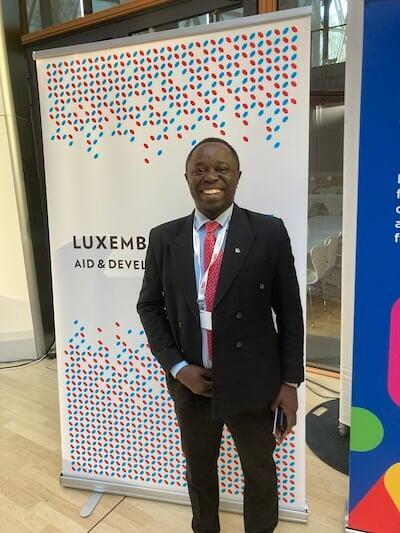
Liberation was founded in 2017 and is now a social business 95%-owned by Patrick Batenze (pictured). Mr Batenze, who joined the company as its CEO in 2022, told Mesofinance Media last week at IF25 in Luxermbourg: “Funding has become harder to access, especially for the most vulnerable groups. Funders have become more driven by the balance sheet, at the expense of impact.”
Thierry Deflandre, who has served as an advisor to Liberation, explained to Mesofinance Media how his philosophy aligns with Credit Sud’s model: “As an impact investor, I am fond of interest-free loans, so I don’t pay taxes, but the money does the work and can be re-invested. That’s why I joined Credit Sud.”
Liberation also has been innovating in the area of governance. As a result of past fraud by branch managers, the microbank is rolling out an advisory board for every branch. This board will supervise the branch and its manager, as well as reporting to central leadership.
Looking forward, Liberation aims to grow within the regions it serves as well as to move into the eastern and northern parts of Uganda. It is also working to digitize its operations more fully.
The microbank lends for purposes such as agriculture, trading and school fees - largely to youth. Liberation also offers savings services, training, crop storage, agency banking, bill payments, money transfers and mobile banking. The organization's balance sheet is valued at the apprroximate equivalent of USD 1 million.
